Information Flows and Zones of Resistance was a research project investigating how translation contributed to cultural exchange, intellectual debate and cultural resistance in Slovakia from the post-socialist 1990s to the contemporary digital period.
The project examined four Slovak cultural and literary periodicals: Aspekt, Revue svetovej literatúry, Kapitál and Verzia. It approached translation as a socially situated practice shaped by translators, authors, editors, institutions, funding, technologies, publication formats and historical circumstances.
Project at a glance
- Project number: 09I03-03-V04-00667
- Principal investigator: Ivana Hostová
- Host organisation: Constantine the Philosopher University in Nitra
- Implementation period: 1 September 2024 – 31 August 2026
- Funding: EU – NextGenerationEU through the Recovery and Resilience Plan for Slovakia
Research
The project combined bibliographic data collection, quantitative analysis, archival and paratextual research, interviews, close reading, Actor–Network Theory and Social Network Analysis. These methods made it possible to study periodicals as infrastructures of cultural mediation rather than simply as containers of individual translated texts.
The research documented translations, translators, authors, source languages, publication dates and editorial contexts. Structured bibliographic data were connected with historical evidence concerning editorial practices, cultural institutions, funding mechanisms, professional networks and material conditions of publication.
Principal findings
- Publicly supported periodicals showed markedly broader source-language diversity than the market-oriented book corpus, while subsidised book translation occupied an intermediate position.
- Source-language distributions reflect broader geopolitical, ideological and cultural changes.
- Periodicals function as infrastructures connecting translators, editors, authors, institutions, funding mechanisms, formats and publics.
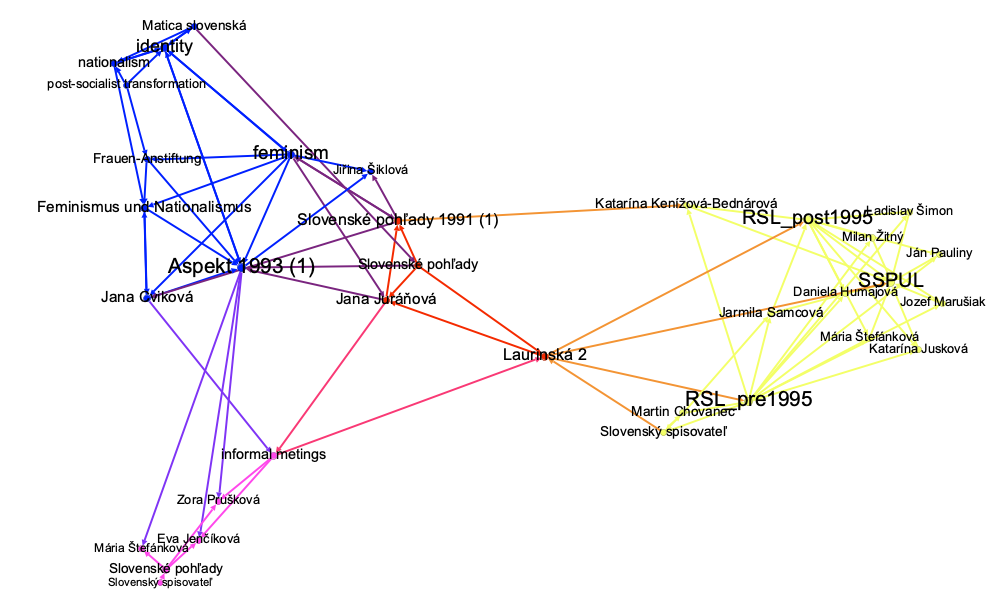
- Aspekt developed as a collaborative feminist translation and publishing network supported by transnational, material and interpersonal relations.
- Combining bibliographic data, Social Network Analysis and Actor–Network Theory provides a transferable methodology for translation history and periodical studies.
Published open-access articles
- Beyond the Market: Translation and Cultural Resistance in Slovak Periodicals
- Periodické štúdiá, feministické myslenie a slovenský kontext
- From Laundry Talk to Transnational Feminism
Final report
The final report provides a synthesis of the project’s implementation, research infrastructure, publications, dissemination activities, methodology and principal findings.
View the complete list of project outputs →
Open data and research infrastructure
The project created and published reusable open-access bibliographic and relational datasets, together with a searchable online research database and discovery tool. The final consolidated bibliographic dataset contains 6,986 unique records documenting translated content in Aspekt, Revue svetovej literatúry, Kapitál and Verzia.
- Bibliography of Translations in Aspekt, 1993–2004
- Bibliography of Translations in Kapitál, 2017–2024
- Bibliography of Translations in Revue svetovej literatúry, 1995–2015
- Bibliography of Translations in Verzia, 2020–2024
- Bibliographic Dataset of Translations in Four Slovak Periodicals: Aspekt (1993–2004), Kapitál (2017–2024), Revue svetovej literatúry (1995–2015), and Verzia (2020–2024)
- Methodological documentation
- Emergence of Aspekt: directed actor-network dataset
- Search the bibliographic database and discovery tool
Project team
Internal project team
Ivana Hostová, Eva Spišiaková, Marianna Bachledová, Igor Tyšš, Róbert Novotný, and Jonathan Eddy.
External collaborators
Natália Tyšš Rondziková and Richard Gramanich Štromajer.
Contact
Ivana Hostová
Department of Translation Studies
Faculty of Arts, Constantine the Philosopher University in Nitra
Email: ihostova@ukf.sk
ORCID: 0000-0003-0901-3759
Funding acknowledgement
This work was supported by EU – NextGenerationEU through the Recovery and Resilience Plan for Slovakia under project No. 09I03-03-V04-00667, “Information Flows and Zones of Resistance: Translation in Slovak Cultural and Literary Periodicals since the 1990s”.